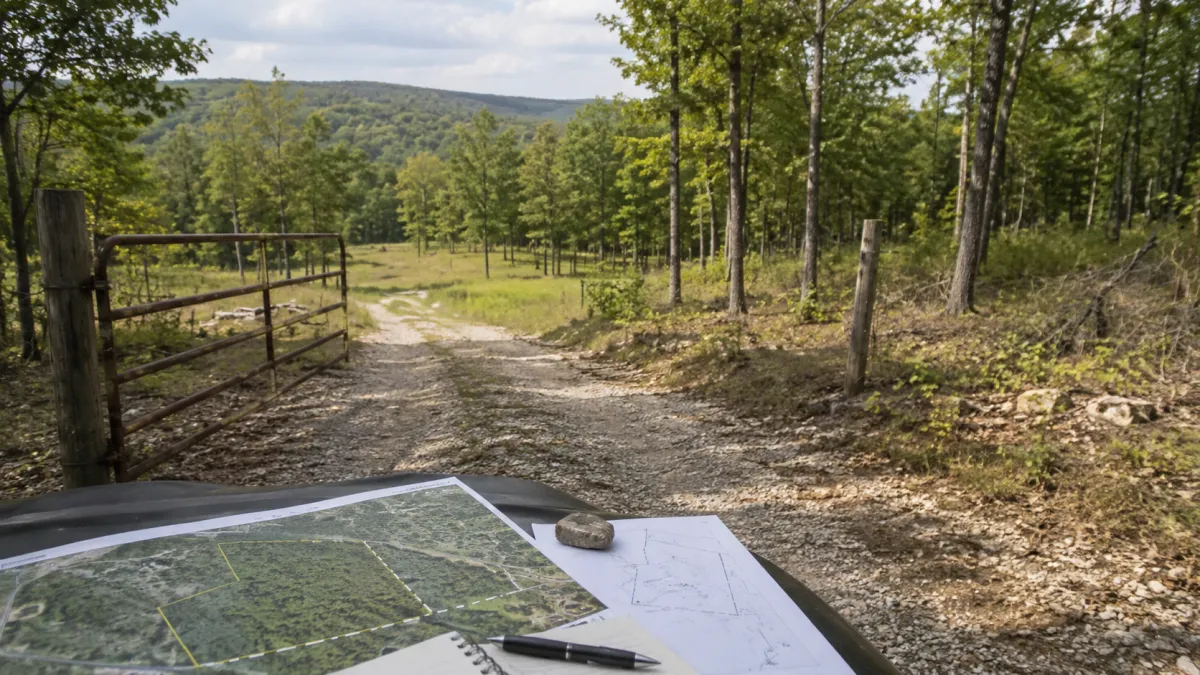
Before You Buy Arkansas Rural Land: Important Details to Check
A visible dirt road does not always confirm legal access to rural land. Before buying, verify ownership, boundaries, restrictions, utilities, terrain, taxes, and other details that may affect whether the property fits your plans.
Rural land can look straightforward from the road. A parcel may have a visible entrance, a nearby power line, attractive trees, and a price that appears affordable.
But vacant land often requires more investigation than buyers expect.
A road may be physically present without providing confirmed legal access. Utilities may be nearby but expensive or impractical to connect. Property restrictions may limit camping, RV use, building, animals, or other plans. Terrain, drainage, taxes, assessments, and improvement costs can also affect whether a property is a good fit.
Before purchasing rural land in Arkansas, buyers should slow down, ask questions, and verify the details that matter for their intended use.
Key Takeaways
A visible road or path does not automatically confirm a legal right to access the property.
Buyers should investigate ownership records, boundaries, restrictions, utilities, terrain, and total costs.
Terms such as “unrestricted” should not be accepted without further explanation and verification.
Purchase-contract protections depend on the specific agreement and should be reviewed carefully.
Property information should be confirmed with the appropriate county offices, title professionals, surveyors, utility providers, or other qualified professionals.
Start With Your Intended Use
Before investigating a parcel, decide what you hope to do with it.
Are you purchasing land for:
A future home or cabin?
Recreational use?
Camping or RV use?
Hunting?
Long-term ownership?
Gardening or animals?
An investment?
A property can be attractive and affordable without being suitable for the buyer’s actual plans.
For example, wooded terrain may be appealing for recreation but require significant clearing before building. A remote parcel may offer privacy but have limited utility access. A subdivision may allow residential construction while restricting temporary camping or RV occupancy.
Knowing your intended use gives you a practical framework for evaluating the property.
Physical Access Is Not Always Legal Access
One of the most important questions in rural land buying is whether the property has confirmed access.
Physical access means there is a road, trail, driveway, or visible route leading toward the land.
Legal access means there is a recognized right to use that route.
Those are not always the same thing.
A path may cross neighboring property. A private road may serve several parcels. A route visible on an online map may not match the recorded property information. In some cases, access may depend on an easement, subdivision road, county road, or another recorded arrangement.
Buyers should not rely only on:
Aerial images
Online maps
Tire tracks
Verbal permission from a neighbor
Statements that a road has “always been used”
Ask the seller what documentation supports access and verify that information through the appropriate property records or qualified professionals.
Buyers should also consider the practical condition of the route. A property may have legal access but still be difficult to reach because of steep terrain, erosion, seasonal conditions, road width, or maintenance responsibilities.
Review Ownership and Title Information
Before purchasing land, verify that the person or company offering the property has the authority to sell it.
Available property records may help identify:
The current owner of record
The legal description
Recorded easements
Existing liens or claims
Delinquent taxes
Deed restrictions
Mineral reservations
Other recorded interests
County assessor information can be useful, but it should not be treated as a complete substitute for professional title work.
Depending on the property and transaction, a buyer may choose to work with a title company or real estate attorney to examine the title and closing documents. Buyers should also understand what type of deed will be delivered and when ownership will transfer.
Understand the Property Boundaries
Online parcel maps are helpful research tools, but they are not the same as a professional survey.
County mapping systems and listing maps may provide a general idea of the property’s location and shape. However, they may not precisely identify the corners or boundary lines on the ground.
Boundary questions matter when a buyer plans to:
Build a structure
Install a driveway
Clear trees
Place fencing
Add a septic system
Use a particular portion of the property
Resolve uncertainty involving neighboring land
Ask whether an existing survey is available. When exact boundaries are important, consult a licensed surveyor about the appropriate next step.
Verify Restrictions and Permitted Uses
Do not assume that owning rural land means every use is allowed.
A property may be affected by:
County or municipal requirements
Subdivision restrictions
Deed restrictions
Property-owner association rules
Building requirements
Floodplain regulations
Septic-system requirements
Easements
Minimum dwelling-size rules
Restrictions involving RVs, camping, animals, or short-term rentals
The word “unrestricted” can mean different things depending on who is using it. It does not automatically mean that no rules apply.
Ask exactly what restrictions are known and request copies of any available covenants or association rules. Then verify the buyer’s intended use with the appropriate county, city, subdivision, or regulatory office.
The question should not simply be, “Can I buy this property?”
It should be, “Can I use this property the way I intend to use it?”
Investigate Utilities and Septic Options
Seeing a utility pole near the property does not guarantee that service is available at the lot or affordable to connect.
Buyers should contact the appropriate providers to ask about:
Electricity
Water
Sewer
Internet or telephone service
Connection requirements
Extension costs
Deposits or service fees
Many rural properties rely on private wells and septic systems instead of public water and sewer.
Septic suitability depends on the property’s soil, terrain, available space, and local requirements. A neighboring property having a septic system does not guarantee that the parcel being considered will support the same type of system.
Buyers planning to build should contact the appropriate local health or permitting office to learn what evaluations and approvals may be required.
Evaluate Terrain and Property Readiness
Photographs do not always show the full condition of rural land.
Whenever possible, buyers should inspect the property or arrange for someone knowledgeable to do so. Important physical factors can include:
Slope
Drainage
Low or wet areas
Rock
Dense vegetation
Soil conditions
Road condition
Washouts or erosion
Potential driveway locations
Potential building areas
A low purchase price does not necessarily mean the property will be inexpensive to use.
Clearing, grading, driveway installation, utility extensions, surveying, septic work, and site preparation can add significantly to the overall cost. Buyers should consider both the purchase price and what may be required to make the property usable.
Check Taxes, Assessments, and Ongoing Costs
Property taxes are only one possible recurring expense.
Depending on the location, buyers may also encounter:
Property-owner association dues
Road-maintenance fees
Municipal or recreational assessments
Special district fees
Utility-related charges
Mowing or maintenance costs
Ask which taxes, fees, and assessments currently apply. Buyers should also confirm whether there are unpaid balances and whether ownership or land-use changes could affect future costs.
Review the Purchase Agreement Carefully
The purchase agreement establishes the rights and responsibilities of the buyer and seller.
Before signing, buyers should understand:
The purchase price
Earnest-money terms, when applicable
Payment deadlines
The closing process
What documentation will be provided
Any investigation or contingency provisions
What happens if a deadline is missed
When possession and ownership transfer
Any limitations on property use before closing or payoff
Contract protections vary based on the agreement. Buyers should not assume that earnest money is automatically refundable or that they may cancel for any reason.
Questions about legal rights or contract language should be reviewed with a qualified real estate attorney.
Ask About Mineral Rights
Surface ownership and mineral ownership may not always be the same.
A prior owner may have reserved or transferred some or all mineral rights. The existence and effect of a mineral reservation depend on the recorded documents and property-specific circumstances.
Buyers concerned about mineral rights should ask whether any reservations, leases, or related documents appear in the available records and seek professional guidance when necessary.
Do Not Rely on One Source of Information
No single website, listing, map, or conversation provides every answer.
A thoughtful rural-land investigation may involve information from:
The seller
County assessor and recorder records
Planning or zoning offices
Road departments
Utility providers
Health departments
Surveyors
Title companies
Attorneys
Property-owner associations
Floodplain administrators
The goal is not to make the process feel overwhelming. It is to identify the questions that matter before the buyer commits.
A Better Land Purchase Starts With Better Questions
Rural land can be a meaningful purchase, but every parcel is different.
The right property is not simply the least expensive parcel or the one with the most attractive photographs. It is the property that fits the buyer’s plans, budget, timeline, and comfort level after the important details have been investigated.
Hopson Land Investments encourages buyers to understand access, utilities, restrictions, terrain, ownership information, total costs, and purchase terms before moving forward.
Our free resource,A Simple Guide to Buying Land, provides a practical starting point for first-time buyers who want to understand the rural-land buying process in plain language.
Learn more and access the guide at:
https://properties.hopsonlandinvestments.com/simple_guide_to_buying_land
To explore available properties and additional buyer-education resources, visit:
https://hopsonlandinvestments.com
This article is for general educational purposes and is not legal, tax, surveying, engineering, environmental, or financial advice. Buyers should verify property-specific information with the appropriate offices and qualified professionals.